Monday, October 10, 2011
Flying Job Scales Tilt Toward Pilots - Jetwhine: Aviation Buzz and Bold Opinion
Flying Job Scales Tilt Toward Pilots - Jetwhine: Aviation Buzz and Bold Opinion: A post by Robert Mark that gives a realistic perspective on the life of a pilot. The rumors about the so called Pilot Shortage are discussed with interesting thoughts from people who seem to have some knowledge, background or have researched the topic. The comments for this post are interesting.

Friday, October 7, 2011
Sunday, October 2, 2011
"Love at first flight"
 |
| The A380 |
The AIRBUS A380, is the first full length double decker passenger cabin aircraft ever. With 54 deliveries and 236 orders from airline carriers all over the world, this aircraft is without question making history, and is definitely a game changer for the airline industry. The very first A380 was delivered to Singapore Airlines 18 months behind schedule. According to Singapore Airline officials, the delay in the delivery of their A380 was worth the wait.
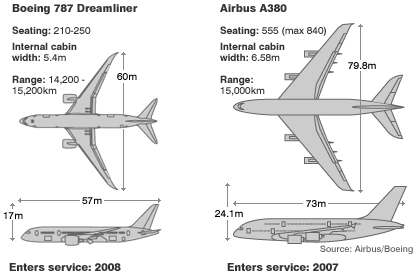
In the three class configuration the A380 has room for 525 people, or up to 853 people in the economy class configurations. The A380's seating capacity, and range of 8,300 nautical miles out hauls the Boeing 787-9 Dreamliner at 210-250 seats with a comparable range of 8,000-8,500 nautical miles. My thoughts are that Airbus has built a winner in the A380 and that it will be a major player in the future of the industry.
What Airbus has banked on in the design of the A380 is the reduced weight that will be seen by the use of advanced composite materials such as carbon fiber. More than 20% of the A380 is made of these advanced materials. The A380 is 15 tons lighter than it would be if it were made entirely of metal.
The following is a list of composite materials used:
- Carbon fiber reinforced plastic
- Glass fiber reinforced plastic
- Quartz fiber reinforced plastic
- GLARE - GLass REinforced metal laminate
The reduced weight and increased seating capacity along with it's quieter more fuel efficient engines makes this aircraft something to take notice of. However for airports to accommodate the A380 modifications will have to be made. I believe that the A380 will be taking the spotlight that Boeing's 747 has enjoyed since its introduction in the early 1970's.
How will this super jumbo effect Airbus in terms of profitability? This article explains how increased profit margins have been seen by the airlines that have taken delivery of the A380. The gamble to build the super jumbo is proven good through the airlines that are seeing increased bottom line profits by putting it into service. This increase shown by the actual service time of the A380 will drive the demand from airlines for Airbus to build more super jumbos in the future.
Stats

Sunday, September 25, 2011
NextGen the Wave of the Future
NextGen in a nut shell is the wave of the future for the way we utilize airspace for air travel. From general aviation to major airlines, the move toward a more efficient use of our airspace through NextGen will be beneficial to all in time.
NextGen Technology differs from today's technology by moving from ground based navigation systems to satellite based navigation. An AOPA article titled NextGen: What's the future of ATC? states that ADS-B is considered the backbone of NextGen because it provides precise aircraft position, altitude, speed, and intent information to other aircraft in the air as well as controllers on the ground. This is only one of the benefits of Nextgen, the following describes the different aspects of NextGen from the FAA's web site starting with ADS-B.
- ADS-B: Automatic Dependent Surveillance-Broadcast
- CATMT: Collaborative Air Traffic Management Technologies
- Data Comm: Data Communications
- NNEW: Network Enabled Weather
- NVS: The National Airspace System Voice System
- SWIM: System Wide Information Management
- AIRE: The Atlantic Interoperability Initiative to Reduce Emissions
The question on the mind's of most people regarding NextGen is who's going to shoulder the cost to implement this new technology. FAA estimates are that it will spend $15 to $22 billion on NextGen, and the airlines and GA will spend up to $22 billion though the year 2025. What that translates to for Americans is that the taxpayers will be flipping the bill for the FAA, and that general aviation and the airlines will cover the rest. I feel that this is weighted a little to much on the taxpayer and not enough on the airlines. The average taxpayer is not going to realize the benefits from NextGen like the airlines will. With airlines you have stakeholders who are mostly concerned with bottom line numbers. With the estimates from the studies about the potential savings to the airlines through efficiency and wait times to the increased number of flights that will be realized, it is clear that the airlines should be more interested in the implementation of NextGen over the FAA. As far as safety is concerned with NextGen and the estimated growth of air travel, the FAA and the airlines should be very cautious about knowing to operate within their limitations and the limitations of the airspace in which they are operating or controlling, be it NextGen or not.
In this article dated September 21, 2011 it seems that for the year 2012 the implementation costs of NextGen will be covered by the FAA. In my opinion a structured system that does not affect private pilots who own or rent aircraft's, and are not flying for profit should be considered. All for profit flights (with some exclusions i.e. training flight) should be targeted to contribute in some way to fund the future of NextGen navigation.
The following two articles are examples of how the FAA is testing/proving how the NextGen system will work and how it will increase revenue and decrease emissions.
Saturday, September 17, 2011
The TSA.......
After reading both articles passed out in class, I have to talk about the Known Crew-Member (KCM) issue. It's not unusual for any government agency to botch things up. Even to a person who only flies occasionally and has very little knowledge of the screening process at airports, could read this article, and think to themselves, "you mean to tell me that the pilots and flight attendants don't have a separate line from passengrs to be screened to get into the airport to do their job?". This is absurd. What is even more baffling to me is the fact that 10 years after 9/11 ALPA is just now making progress on this issue. Although the KCM program has only been extended to pilots at this time, there is talk about including flight attendants to the program as well.
Another topic worth noting is the manufactured importance of an agency about it's own existence. This comment may not be entirely true, however it is becoming more prevalent in the industry of the TSA. Audry Hudson writes in her article, TSA Creator Says Dismantle, Privatize the Agency that the TSA has gone form a estimated cost of a couple-billion-dollar enterprise to close to $9 billion. This jump in cost may be directly or indirectly related to the new boogeyman created by the TSA as stated by Jim Coyne in the article "Terrorism's Impact on Business Aviation".
The business of keeping terrorism out of the skies has ballooned into an agency out of control, and that under actual testing of itself from within has proven it to be only 60% effective. My faith in the TSA is less than what I would like it to be and believe that Rep. John Mica said it best when he said that "it's an agency that is always one step out of step". It seems unfortunate that the main thing the TSA has become good at is being the most hated agency in the United states.
The TSA is a reactive and not a proactive agency. The only way for any agency charged with the security of anything is to find ways to thwart attacks before they happen. This point is made well by Isaac Yeffet in the article How the Israelis do Airport Security, where he says most of our measures are reactive, and calls them "A patch on a patch". We have read in the articles provided that the United States is lagging in comparison to other countries. However since 9/11 we have been successful in stopping any attack that would have succeeded. That's not to say that these were stopped before the person boarded a flight with some intention of an attack. But that the person in question was neutralized in flight and arrested after the airplane landed. This is clearly reactive security measures. Even in the case of the shoe bomber where the TSA had many warnings about the person, well in advance. With no absolutes in how to make the TSA function effectively and efficiently, we can only hope that the people within the agencys can continue to improve upon what seems to be a security fiasco by working in cooperation with every side of the spectrum.
Another topic worth noting is the manufactured importance of an agency about it's own existence. This comment may not be entirely true, however it is becoming more prevalent in the industry of the TSA. Audry Hudson writes in her article, TSA Creator Says Dismantle, Privatize the Agency that the TSA has gone form a estimated cost of a couple-billion-dollar enterprise to close to $9 billion. This jump in cost may be directly or indirectly related to the new boogeyman created by the TSA as stated by Jim Coyne in the article "Terrorism's Impact on Business Aviation".
The business of keeping terrorism out of the skies has ballooned into an agency out of control, and that under actual testing of itself from within has proven it to be only 60% effective. My faith in the TSA is less than what I would like it to be and believe that Rep. John Mica said it best when he said that "it's an agency that is always one step out of step". It seems unfortunate that the main thing the TSA has become good at is being the most hated agency in the United states.
The TSA is a reactive and not a proactive agency. The only way for any agency charged with the security of anything is to find ways to thwart attacks before they happen. This point is made well by Isaac Yeffet in the article How the Israelis do Airport Security, where he says most of our measures are reactive, and calls them "A patch on a patch". We have read in the articles provided that the United States is lagging in comparison to other countries. However since 9/11 we have been successful in stopping any attack that would have succeeded. That's not to say that these were stopped before the person boarded a flight with some intention of an attack. But that the person in question was neutralized in flight and arrested after the airplane landed. This is clearly reactive security measures. Even in the case of the shoe bomber where the TSA had many warnings about the person, well in advance. With no absolutes in how to make the TSA function effectively and efficiently, we can only hope that the people within the agencys can continue to improve upon what seems to be a security fiasco by working in cooperation with every side of the spectrum.
Saturday, September 10, 2011
Automation VS. Skill
There is no piece of automation that can replace good ol' piloting skills. Granted automation can fly more precise and help with pilot fatigue, but you can't take being able to fly the plane by hand with a grain of salt.
In reading these articles,"Automation in the air dulls pilot skill" and "Should Airline Pilots Fly More -- Or Less?", what I see in most of the author's resolution is to get the pilot back to the basics and hand flying the aircraft to keep their skills sharp. Although this school of thought is true, you can't place to much emphasis on keeping sharp just by hand flying alone. The modern cockpit is full of integrated systems and controls, all of which are important for the pilots to be proficient in. The real word scenarios that are well documented should be made into training drills using all the capabilities of the aircraft. This is more than just concentrating on the basics of hand flying. This type of training needs to be conducted and structured so that pilots are forced to make decisions in flight all the way to completely disconnecting all automation, hand flying the aircraft in instrument and visual conditions, executing an approach, and landing safely on the ground.
In this discussion the old saying " they don't mak'em like they used to" is very fitting. Pilots of old were trained to fly using less automation in the cockpit. When faced with "automation surprise" the older more experienced pilots are better equipped to handle hand flying; not just because of their experience in the cockpit but because of their experience flying aircraft which were flown by hand more than by automation. These pilots have been retrained to fly modern aircraft filled with modern technology, however they still posses the pilot skills, albeit rusty, to handle just flipping off the autopilot, grabbing the controls, interpreting the instruments, and recovering.
Captain Sully in his comment that the pilots and the technology are failing together is an issue that I think needs to be very closely examined. The technology factor is never going away, and statistics don't lie, air accidents are declining due to technology. This leaves the task of integrating not only the aircraft with technology, but also how to integrate the human with technology.
Click here to read another article on the subject.
In reading these articles,"Automation in the air dulls pilot skill" and "Should Airline Pilots Fly More -- Or Less?", what I see in most of the author's resolution is to get the pilot back to the basics and hand flying the aircraft to keep their skills sharp. Although this school of thought is true, you can't place to much emphasis on keeping sharp just by hand flying alone. The modern cockpit is full of integrated systems and controls, all of which are important for the pilots to be proficient in. The real word scenarios that are well documented should be made into training drills using all the capabilities of the aircraft. This is more than just concentrating on the basics of hand flying. This type of training needs to be conducted and structured so that pilots are forced to make decisions in flight all the way to completely disconnecting all automation, hand flying the aircraft in instrument and visual conditions, executing an approach, and landing safely on the ground.
In this discussion the old saying " they don't mak'em like they used to" is very fitting. Pilots of old were trained to fly using less automation in the cockpit. When faced with "automation surprise" the older more experienced pilots are better equipped to handle hand flying; not just because of their experience in the cockpit but because of their experience flying aircraft which were flown by hand more than by automation. These pilots have been retrained to fly modern aircraft filled with modern technology, however they still posses the pilot skills, albeit rusty, to handle just flipping off the autopilot, grabbing the controls, interpreting the instruments, and recovering.
Captain Sully in his comment that the pilots and the technology are failing together is an issue that I think needs to be very closely examined. The technology factor is never going away, and statistics don't lie, air accidents are declining due to technology. This leaves the task of integrating not only the aircraft with technology, but also how to integrate the human with technology.
Click here to read another article on the subject.
Friday, September 2, 2011
Aviation Topics Intro
Not sure what it was that sparked my interest in flying, looking up at passenger planes wondering where their headed, my interest in mechanical things, traveling, not being a passenger (ever) no matter what type of vessel, my first flight, or my first landing. There is no greater fun than landing an airplane; this most likely is the reason that of all of the different things I've gotten into, flying is the only one I can not seem to not do.
The path to where I am as far as certificate level goes is much farther than I ever imagined. When I began flying, I knew that it was in my heart. Never realizing that becoming a marketable pilot was something that I could possibly attain.
Getting here has been quite a journey. My training has been broken into 5 parts.


My goal at this point in flight training is to become a CFI and eventually MEII, I'm not sure where it will take me, however I am sure that I'm headed in the right direction. Currently I hold a commercial instrument certificate, working on multi-engine add on.
The path to where I am as far as certificate level goes is much farther than I ever imagined. When I began flying, I knew that it was in my heart. Never realizing that becoming a marketable pilot was something that I could possibly attain.
Getting here has been quite a journey. My training has been broken into 5 parts.
- The first part I call "the beginning", is when I took my first flight with the flight instructor and DPE at a little flight school at Grosse Ill Municipal Airport. I soloed in under 12 hours of flight training. After growing weary of driving 45 miles to get to the school and some personal stuff, I hung it up for around 6 months. During that time I could not stop thinking about flying, it was always in the back of my mind.
- The second part I like to call "swing and a miss," was at a flight school called A Different Approach at Willow Run. This was a great school, or so I thought. They had new Diamond Katana DA 20 trainers that were a blast to fly. This all ended when the flight school went belly up, (probably because one of their instructor's experienced an engine failure just after departure from Mettetal in Canton in their only Cessna 150).
- The third part is titled "I'm going to be a what !" I began another round of flight training at Mettetal air port with a guy who was aspiring to get into the majors named Ben. I was all the way up to making an appointment with a DPE out of Pontiac air port named Mary Carpenter. It was in late December 1998, I was scheduled to take "the ride" first thing in the morning. I was all set to go, got up, tied up a few loose ends when my phone rang. It was Mary, she called to tell me that she was not feeling very well and needed to reschedule. After we hung up I just thought, well I'll call her back and reschedule next week sometime. Then, my wife Laura comes into the living room to ask me when I thought I would be home. I replied that Mary had cancelled and we were going to reschedule. Then she says, guess what? I said what? she said, your going to be a dad! I was rushed with a million feelings all at once. That day I'll never forget. Needless to say I did not call Mary back.


- The fourth part is "finally." Five years later I hooked up with Cal Downing back when he was running Cal's flying service out of Willow Run. I earned my private pilot certificate with none other than DPE Bill Lewis. Both of which are ironically on staff at Eagle flight center.
- The fifth part is basically "OK enough is enough." After flying rentals out of a bunch of airports until 2009 I had given in to the never ending need to be flying. I began formal flight training in EMU's Aviation Flight and Technology program.
My goal at this point in flight training is to become a CFI and eventually MEII, I'm not sure where it will take me, however I am sure that I'm headed in the right direction. Currently I hold a commercial instrument certificate, working on multi-engine add on.
Subscribe to:
Posts (Atom)